Wednesday, 2 September 2015

A few days in the country

The ride from Paris to Mamers can be over in around two hours without much effort. It takes a lot more concentration to make it last three or four days.  That is what we set out to do. Hiring a car in Chartres and driving via Brou, Illiers-Combray, Bonneval, Nogent le Retrou and Sure gave us a late summer sojourn in an area little explored by foreign tourists.

Brou

48°10'48" N 1°23'11" E

Located on the road between Paris and the Loire Valley and close to the Cathedral at Chartres, Brou has prospered as a place of trade for more than 800 years.  The market has been operating on a Wednesday since before 1200.  The long term prosperity of the region is reflected in the Romanesque church and chapel, the late 19th century Town Hall, wooded houses with continuous occupancy by a single family for more than three hundred years and smaller private residences with outside laundries on the river reflecting the response to the cholera epidemics of the late 19th and early 20th century. The local tourist bureau has combined these into an informative and pleasant walk which make this town worth an overnight stay.

Illiers-Combray

48°17'59" N 1°14'36" E

Illiers-Combray is famous for only one thing. Marcel Proust spent summer holidays here with his aunt and uncle and in the process ate Madeleine cakes which he later recalled in his famous book « À la recherche du temps perdu » (In search of lost Memories).  As a result, the home of his hosts has been transformed into a shrine to Proust which just had to be visited.  An enthusiastic, helpful guide, a curious tour and a superb collection of photographs of the good and the great from the early 20th century made the Thursday afternoon diversion worth the effort. 


Bonneval

48°10'56" N 1°23'5" E

Bonneval shares many of the characteristics of Brou.  The main difference is that it lies on the confluence of two small streams and has maintained its defensive moats and walls more or less intact until the present.  This provides the opportunity to walk around the small town to view the well maintained garden areas, the old fortifications, some interesting houses, gates, washing places and bridges whose ages spans over several hundred years.  The church is large and impressive, dominating the middle of town.  The morning walk and lunch by the water made for a restful and pleasant stop on the road.


Nogent le Retrou

48°19'18" N 0°49'15" E


Nogent le Retrou for me has been simply the closest train station to Mamers where I was dropped or collected during visits to Dominique’s family.  To Dominique, daughter of a butcher, it is also the location of the abattoir.  After a short morning visit, it reveals itself as a pleasant town which could be any of 10,000 French towns, with a thriving Saturday morning market and a café with drinkable coffee.


Suré

48°22'8" N 0°23'53" E


Suré a little farming village outside Mamers hosted a weekend of Agricultural Field Day events. Most interesting was the historical agricultural equipment and the man carving a human figure into a log using a chainsaw.

A different view of Paris


It is easy for a trip to Paris to fall into a groove of the standard, admittedly spectacular, sites. This time we decided not to follow that path, but instead to explore some areas that we have overlooked in the past.  This decision was made easier by the fact that it was Monday and everything else was closed!

Canal Saint Martin

Grey Nomads at the Helm

First on the agenda was Canal Saint Martin, starting at Place de la Republique and walking along the line of the canal which was the main delivery artery for grain, building materials and a range of consumer goods, as well as a supply of fresh water for Paris.  Construction took place in the first quarter of the nineteenth century with the final structure linking the Ourcq River and the River Seine.  The canal infrastructure, including swing bridges and locks are still functioning, but the main users appear to be the occasional leisure boat with the French version of Grey Nomads at the helm.


Swing Bridge


The Place de la Republique maintains its left wing character as it continues to attract protest and comment about whatever is the latest burning issue.  Charlie Hebdo featured prominently among the many painted slogans, posters and pictures about the square.  Of course, not all of the dissenters are rigorous about spelling and grammar, but there is always someone to lend a hand.


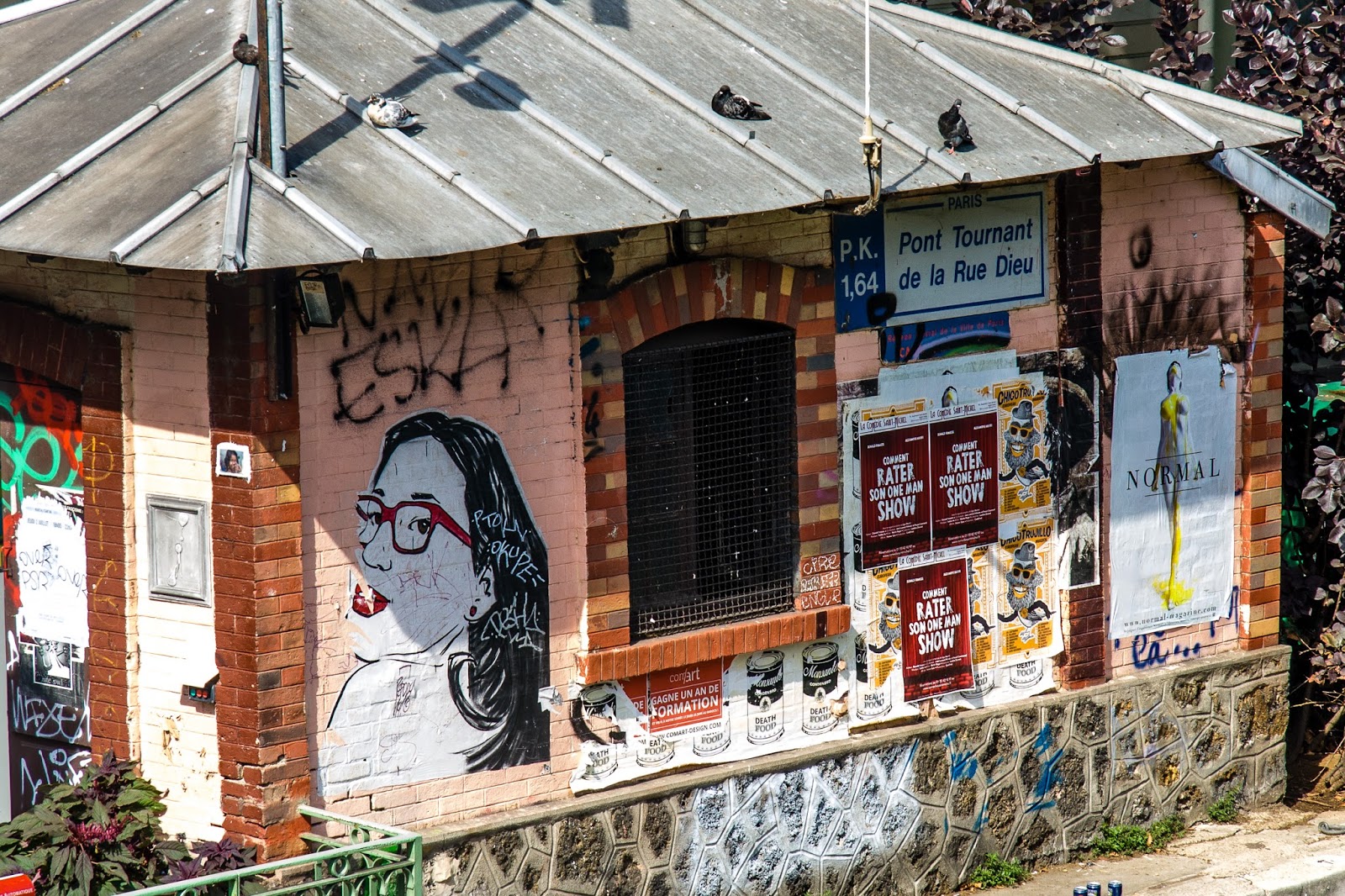
The area of the canal itself has that slightly gritty feel of a quarter which is in the process of gentrifying, but somehow is trying to resist the change. It is characterised by a high volume of graffiti side by side with chic cafés, emerging fashion brands and art bookshops.  It also provides a (slightly frightening) vision of what Paris may have been had the international enthusiasm for urban renewal in the 1960s taken hold in the 16th Arrondissement. There are examples of 60s and 70s apartment buildings next to the more traditional French buildings which demonstrate that even the French fail in taste sometimes.  At least they had the sense to limit the extent of their failure!  The area is generally safe, but the occasional sideways glance makes the wary traveller check the security of wallet and phone on regular occasions.


Nonetheless, the canal has been important in Parisian post war culture.  The footbridges over the canal and the squares and streets in the area are instantly recognisable to anyone who has seen too many French movies from the sixties and seventies. 

We fell for all the recommendations of the tourist website, and had a Sauterne at the Café Prune and took pictures of the standard scenes. However, it did not feel as bad as holding a camera above a crowed Louvre to take a picture of the Mona Lisa, because it is impossible to see through the crowd in front of you.


Bibliothèque Nationale de France


Rabin Garden
We set out to visit the Bibliothèque Nationale de France by catching the Metro to Gare de Lyon and walking through the area of Bercy where the French Finance Ministry has established itself in recent years.  Wandering through the Park de Bercy we happened upon the Yitzhak Rabin Peace Garden which, as its name suggests, is a park devoted to the memory of the former Israeli Prime Minister who was assassinated while trying to negotiate peace with the Palestinians.  I could not help thinking of Andrew Bolt, who would probably have had several problems with the park, including the overall peace message, the theme of sustainability and the location of the Climate Change advice centre within its confines. 


SDB Footbridge


We approached the Bibliothèque by way of the very impressive Simone de Beauvoir Footbridge across the Seine. On the East bank of the river was a series of statues which recognised the various nationalities from around the globe, and provide an ideal place for racist graffiti.


BnF, as it is known to the regulars at Quay Bercy, is a completely different experience to Canal Saint Martin.  Commenced by Francois Mitterrand and opened by Jacques Chirac, it is the new(ish) home for the archival library of France.  The institution promises to « Partageons la culture » and a thoughtful contributor reminds the institution that this sharing should remain « Gratuitement ». A warning sign on the way cautions that it will take 150,000 years to read all of the books in the library.  We are sure that this does not include the time to navigate the French bureaucracy to acquire a reading card, nor does it allow for the closure on Mondays and the August holidays, all of which have priority over the actual reading.  In fact, we did not come to read, but just to absorb some of the atmosphere of this impressive building and its contents. 

The architect has placed four towers on the corners of the site to house the books, and developed an underground world for the human access in the centre of the site.  The library, apart from storing and providing access to books and manuscripts, holds a wide range of cultural events, none of which are accessible on our visit.

One interesting surprise was the discovery of the Coronelli globes inside.  They were commissioned by Cardinal d’Estrées in 1683 as a gift to King Louis XIV and were originally destined to be kept at Versailles, glorifying the sun king. The size of the globes meant that they have been difficult to sort and display effectively.  In recent times they have been displayed at Pompidou Centre and Centennial of the Grand Palais in 2005 but have proven impractical as permanent exhibits due to their size – they are each 3.84m in diameter.  Now they have an appropriate home at the BnF.

A worthwhile visit, but don’t expect to read much.

Opéra Restaurant

A more traditional but at the same time modern Parisian experience rounded off our stay.  We ate at the new(ish) Opéra Restaurant, located within the opera house – within but not of.  Although the original design of the Opéra envisaged a restaurant back in the late 1800s, it was only achieved in 2011.  The architect, Odile Decq, a highly awarded French architect, was required to build the restaurant without touching or using any of the existing structure of the historic building.  The design is a masterpiece, the food is worthy of the building, and the service was great.  

Tuesday, 1 September 2015

Stuttgart on a Sunday - Cars and More Cars

The Mercedes Benz Museum

In order to explore the car industry, we devoted our second day in Stuttgart to visits to both the Mercedes Benz Museum and the Porsche Museum.  


As Mercedes Benz has grown up with the car industry, and constantly broadened its base to include luxury cars for the wealthy and influential, as well as tractors, trucks and busses for the rest of us, the museum was more interesting from a social history perspective.  Here you can find a short slide show of some of the highlights of the visit. 


The Porsche Museum

The Porsche Museum, devoted as it was the to design prowess of the Porsche father and son, was more as one would expect from a car museum – closer to a motor show devoted to one brand over a period of time. There was considerable focus on the Porsche racing heritage. As a result, it was less interesting to the general visitor.  It did have the better entrance, though. 

The Entry to the Porsche Museum
For the petrol heads, for only €99, it was possible to drive the latest model on a closed road.  It would have been wasted on me, but there was a queue.


They had so many, I am sure they would not miss just one.


Stuttgart – cars, philosophers and fountains


I was impressed in Seattle when I discovered that the city was the home of Microsoft, Boeing, Amazon and Starbucks, but Stuttgart has a much more impressive record.  Home of Porsche, Daimler and Benz, and Bosch, it claims to be the birth place of the international motor industry, and while others may dispute it, if the evidence of the Mercedes Benz museum is to be taken on face value, the first car, bus, motorbike, motorboat and powered airship all had their beginnings here.  Importantly, the basic framework of the car and the key components of the internal combustion engine emerge from the mechanical engineering brilliance of Wilhelm Maybach, who worked as Daimler’s chief engineer and was responsible for the spray carburetor, the honeycomb radiator, the general concept of the chassis used in every car since and the first four cylinder petrol engine.  Not a bad résumé for someone orphaned at the age of 10. 

Stuttgart is of course more than cars and the motor industry.  The wealth created from that industry allowed culture and civic development to flourish.  For example, it was the birthplace of Georg Wilhelm Friedrich Hegel, one of the prominent Romantic Philosophers.

Fountain outside Stattsgalerie

Our first day was devoted to sampling some of that culture, including the local wine, beer and food.  We tried the cultural walk around Stuttgart recommended by the tourist bureau, starting at the Stattsgalerie, which houses the best selection of Swabian altar panels from the 1350 to 1550.  I don’t think there are too many other competitors for this title, but it was impressive – including the fountain outside.  


Then we found ourselves at the very creative and well curated Baden-Württemberg House of History.  This museum shocked us from the outset, with a bust of Napoleon Bonaparte taking pride of place at the entrance.  It seems that the locals had little time for the Prussians, and were happy to rush into the arms of anyone else but them.  The museum covered all aspects of life – unfortunately all in German – including the local timber industry, a fascinating set of photographs of weddings and families for every year from the present to as far back as the technology would allow; a close examination of the world wars; a segment on the religious life of the state which has been at the centre of mainstream Christian religion from almost the beginning; local wine making and the development of the region.  Unfortunately, no photos allowed.

After lunch and a quick stroll past the major buildings – including the new library which by all reports is wonderful inside, but closed on Saturday afternoons in September – we examined the Saturday afternoon café society of Stuttgart. It is more of a beer society really, but a good one nonetheless.  Dominique went native, and is now speaking German almost continuously, even to me. The result of her efforts to order a small beer is illustrated below.


We noticed throughout the day that much of the excess capital generated by the good burghers of Stuttgart has been devoted to the construction and operation of fountains.  They are everywhere, and here are just a few.  Sydneysiders will recognise the design of at least one of them.


Sunday afternoon brought another beer, and entertainment by the jazz society at the local bandstand – they broke into rock and roll and in English, country and western in German and 50s French songs in French – and they recorded it all on video.  Look out for the next You-Tube viral video.  


Dominique again ordered two small beers.  I think she has nailed this German thing.

Small beer means half a litre